
It was tempting to paraphrase the title of the movie Dr. Strangelove and call this article “How to learn to stop worrying and love cooking”.
Cooking seems to have lost its attractiveness over the years. Actually, this is a bit disappointing. There seems to be some misconceptions about cooking. Many people seem to think it is difficult or it is time consuming. They see it more than a chore than a pleasure. It can be a chore if you look at it as such, but there are ways to learn to enjoy cooking.
Personally, I enjoy cooking. I have been cooking about everyday for the past 45 years. My cooking must be good because my wife has nicknamed me “the kitchen god” and our guests always enjoy the meals I prepare. When I visit my family, they are always keen of having me preparing meals, too. But just like Rome was not built in a day, I had to go through a learning curve. And so can you!
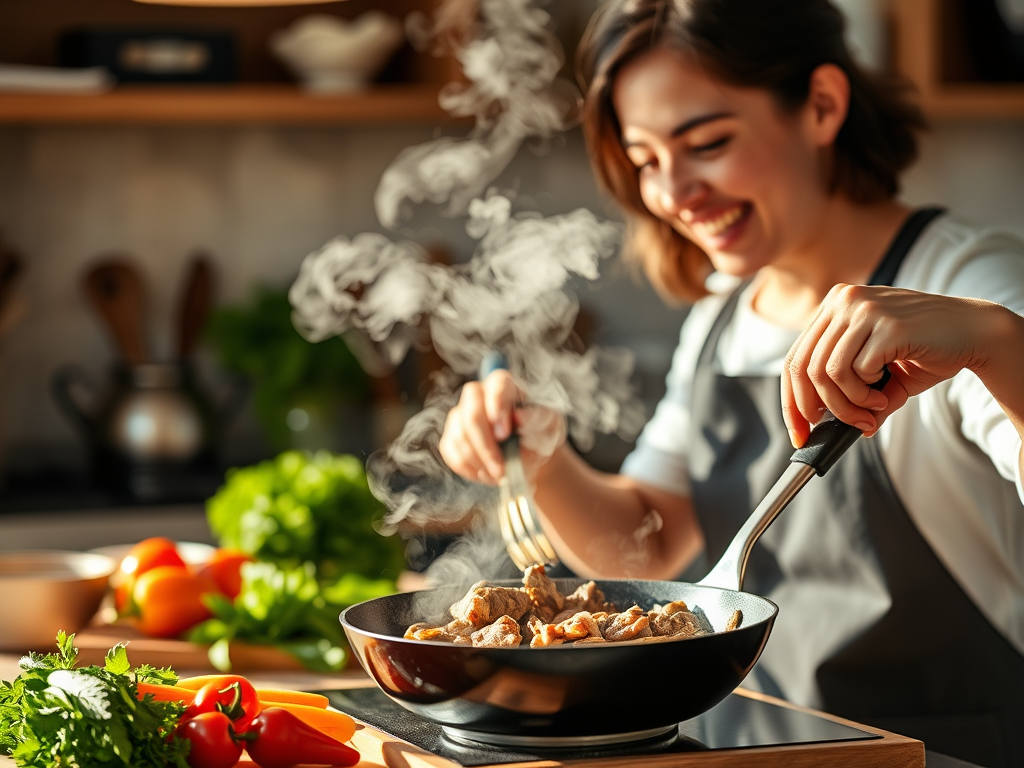
There are a few simple tips that help greatly to find some fun in cooking meals. Here are a few of the most useful.
The first thing is to not put pressure on yourself. If you do not cook, just start slowly. Just cook only one day or two a week. Take it easy and see how it goes.
My second tip would be to start with something simple. When I started to cook for myself as a high school student, I would make something really simple like ground beef and mashed potatoes or pasta with a slice of ham. These are easy dishes to make and it is difficult to mess them up. Yet, I did mess up sometimes, mostly because I did not pay proper attention, but that is something you learn to correct quite quickly. Anyway, never try to get to cooking with fancy recipes. They usually require skills that you may not have, yet. There is nothing more frustrating that ruining a meal and you should have no reason to set yourself up for failure.
Ease into it gently. A simple dish consisting of some meat in the frying pan with a side of rice, pasta or potatoes with a couple of vegetables that you boil for a few minutes are really easy to make and most people like such dishes. To make the dish nicer, there is nothing like making some sauce. Sauces should not be underestimated. they are the secret behind great cooking. Without sauce, most dishes are rather dull and sad. Make some sauce and it feels like a fancy restaurant.
With sauces, take it easy, too. You do not need to start with a hollandaise. If you prepare some meat in a pan with a bit of butter, you will get nice brown bits. Just heat the pan at the max and pour some water on the brown bits and juices. it will boil right away and just scrape the bottom of the pan with a wooden spoon and you will get a fantastic brown sauce with all the delicious flavors of your meat. Pour the sauce on the meat and your guests will be very impressed. You want to go fancier? Just add a bit of cream in that brown sauce and you will be amazed. Trust me, it is incredibly easy to make and it will wow your guests.
Earlier, I mentioned pasta. This is one of the easiest dishes to make. Just make a sauce with some crushed tomatoes and some garnish of some vegetables (personally, I like onions, celery, carrots or zucchini) or meat or whatever you like, and you will have a delicious dinner in less than half an hour.
One particular food that people seem worried about making is fish. It is understandable if you try to make fish in a frying pan. Overcooking the fish will make it dry and it probably will crumble in the pan if you are not very experienced. The solution is to buy frozen vacuum pack fish. Just put the pack in boiling water for 10 minutes max. Then, cut the plastic pack open and slide the fish on a plate. If you wish some sauce, just melt some butter in a pan with lemon juice and some parsley and, once again, it will taste like what you would get in a fancy restaurant.
Other simple dishes to make are soups and salads. In my household, my vegetable soup is a favorite. All I do is to chop somewhere between four and ten different kinds of vegetables that I put in a big 4-liter pot of salted water. Once it is all cooked, which is about 15 minutes to get to boil and about 15 minutes to cook, I grind the soup with a hand blender. You might want to skip that part, or you may choose how chunky or finely you want to grind. That is the beauty of cooking: there is no absolute rule. You prepare food the way you like it. The pot may take some time to prepare but it lasts us for about five days, so just pick a day that suits you to spend that time, and you will have delicious soup for days within a couple of minutes in the microwave. Here, too, just add a teaspoon of cream in your bowl and the basic veggie soup with turn into a fancy velouté! Salads are even easier and faster to make. Just choose all the veggies you want to put in it and other ingredients if you wish like hard-boiled eggs or canned fish. it is all up to you. The salad is ready in a few minutes and it is always nutritious. If you want to make fancy just add some herbs or bits of nuts or almonds. A simple vinaigrette (1 volume of vinegar with 2 volumes of vegetable oil and a pinch of salt) is the perfect dressing for a salad.
These are just simple examples that show that cooking does not need to be difficult or time consuming. The key is to not take on more than you can handle. If you start gently, you will gradually will want to try new dishes and be a bit more adventurous. Just allow yourself the time to gain experience. The rewards will be many.
Copyright 2025 – Christophe Pelletier – The Sensible Gourmet – The Happy Future Group Consulting Ltd.



 Other categories that showed an amazing comeback are flour and pasta. What a change of heart! Here, too, consumers went back to the basics. Baking and cooking have been among the most popular activities during the pandemic lockdown. What happened to carbs and gluten? Weren’t they supposed to be the incarnation of all evils? Weren’t they supposed to make us fat and sick, to a point where self-proclaimed sometimes questionable dieticians and marketers worked really hard to convince us to not buy any of those staple products but instead choose for the much more expensive gluten-free alternatives that would fill their pockets? Well, not only the pasta, flour and baking sections in the stores were desperately empty because the staples products were back in favour, but the amazing part was that the shelves with gluten-free and other carb-alternative diet products were left about untouched. Flour is back, and so is bread and baked goods because 1) they are fun to make, 2) they are cheap to make and 3) they are good for you, of course with moderation that is. That is the stuff I am advocating in this blog. It seems that the pandemic has made many people see the many advantages of preparing food yourself. Baking and cooking are so much more than just that. They are an act of love and they are a unique way of connecting people and generations. This is what we are witnessing here. The need for social contact and love, the second layer from the bottom in Maslow’s pyramid is as popular as the bottom layer about basic physical needs. Baking is just a trip back to grandma’s kitchen. It is a reminder of our childhood and the atmosphere of grandma’s kitchen and the complicity that it brought around the stove. It is a reminder of the happy moments of tasting warm dough and making a mess with chocolate cream. In the current uncertain times, it is a safe haven where love and comfort bring us a badly needed protection from a harsh reality.
 Bread seems to have been created some 10,000 years ago. It would not be surprising is the first bread happened by accident, as most tasty foods have. Perhaps, someone left a mix of flour and water to close to the fire and found a delicious surprise later on. Who knows? It does not matter. Clearly, it does not need high-tech tools to make bread, just a bit of elbow grease. About every region of the world has its own particular type of bread, and they all follow the same basic recipe. Everyone who has baked bread at home will tell you the pleasure of the smell of warm freshly baked bread around the house. There is something about the smell of fresh bread that makes you hungry, or at least gourmand. And anyone who has eaten fresh bread from the oven will tell you: none of the breads you can find in supermarkets matches the taste and aroma of the real thing.
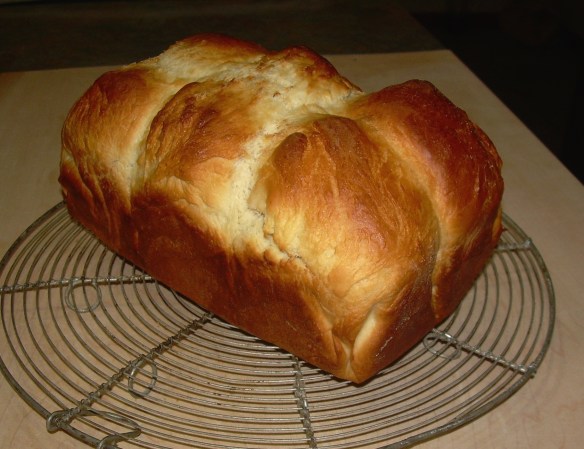
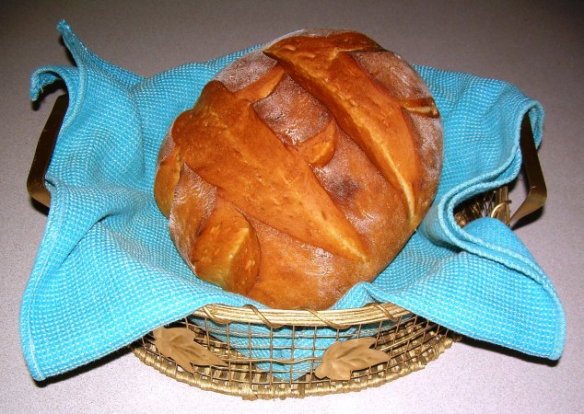
 The fun begins quite a bit before breaking the crust of the finished warm bread. Although I have a bread machine, I really prefer making the bread by hand myself. I like the bread machine and it is convenient, as it does everything and I can use the timer to have fresh bread early in the morning, but it is not quite the same as hand-made (the bakeries that charge an obscene amount of money for this very basic food will call it “hand-crafted”, but hand-made is the same). Letting the yeast rise and kneading the dough are already tantalizing the senses. Personally, I find that using a mix of regular flour with whole wheat flour makes bread with a stronger flavor, a bit of old-fashioned bread type. I also like to make a “levain” and let it evolve overnight. It seems to enhance the aromas of the dough and of the bread. By the reactions I get at home when the bread is ready, I clearly am not the only one thinking this way. And that is the other joy of making bread: the sharing of the bread with others. It is amazing how something this simple can generate such happiness, conviviality and smiles. You should try it and, as I said before, it is really easy to make. The only thing that took me some time to quite do right was how to fog the oven by saturating it with water steam, which helps make the nicest crunchy and golden bread you can think of. All the pictures included in this article are from my kitchen. As you can see, home-made breads look good, and they taste good, too.
 Just give it a try. It does not take all that much time and it is a better use of time than being glued on a smartphone waiting for God knows what.
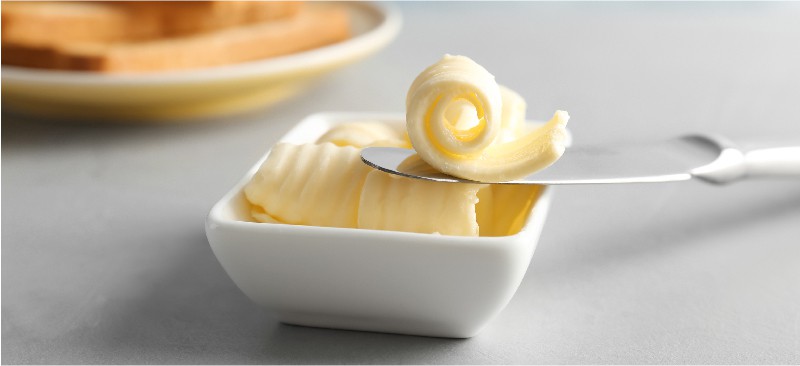 There are some interesting consequences of the fatty acid composition of edible fats. First what is meant by saturated or unsaturated relates to the presence (unsaturated) or absence (saturated) of double bonds in the molecule of a fatty acid. An unsaturated fatty acid molecule has the ability to combine with oxygen or other atoms. When a fat combines with oxygen, it becomes oxidized, which is commonly known as rancid, with the bad taste that goes with it. Saturated fats do not have bonds that can open and combine with other elements. They are more stable. And that was the whole idea of margarine as a substitute for butter. Butter, as you probably know, can get rancid, especially if it is not refrigerated. A way to avoid that is to add ß-carotene, an orange pigment and precursor of vitamin A, to the butter, which is common in the dairy industry. The purpose of margarine was to have a butter substitute that would not get rancid and to do that, the process consists of hydrogenating (adding hydrogen to) the fat. The double bonds open and attach hydrogen atoms, thus leaving no space to oxygen to attach and make the fat rancid. Basically, the original margarine was fully saturated fat. It is ironic to know that when in the same time the margarine industry did all it could to discredit butter, which is a rather complex mix of long and short fatty acids, although mostly saturated. And it is also interesting to see that over time, margarine producers actually produced vegetable fat spreads that mimic butter much more than the original margarine ever would. Since I am addressing the processing of fats, unsaturated fats can turn into two different types called Trans and Cis. We have all heard about the risks of Trans fats and they are banned about everywhere nowadays. Trans and Cis are two spatial molecular configurations of a same fatty acid molecule, depending on which side of the molecule the radical is. This tiny difference has serious implications for metabolism and health, though.
 Do you see now why a Pata Negra pig’s ham tastes so good? It is a pig that is kept in semi-wilderness in Spain and feeds for several years eating chestnuts and other shrubs in a region where vegetation is sparse. It is quite different from a pig that is fed intensively and slaughtered at 6 months of age or so. The price is not the same, either.


 The Sensible Gourmet