Perhaps you saw it in the news. There has been a lot of excitement about butter in Canada in the past few days. It made the news headlines about all around the world. The butter in Canada seems to have become harder, and harder to spread over the past year or so. The blame seems to be about the use of palm oil in cow feed. This is interesting because it brings up some matters that I had addressed in my article on fats, earlier on in this blog (in particular read the sections about margarine vs. butter and how the fatty acids profile affects the physical quality of the product). Here are a couple of links about the “buttergate” in which you can find more details.
https://www.bbc.com/news/world-us-canada-56175784
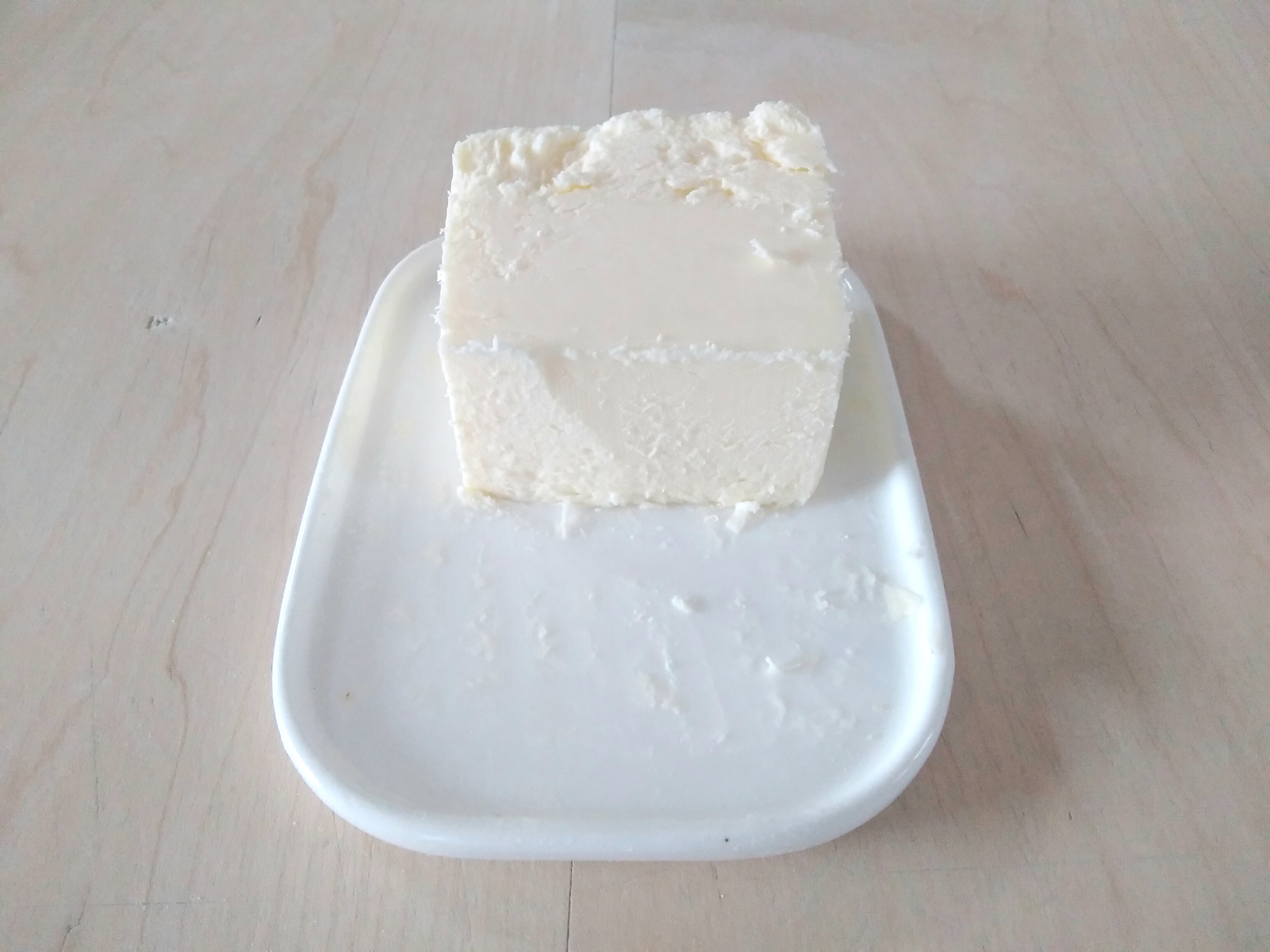
Butter or frozen cottage cheese?
The funny thing is that I found butter to be a lot less enjoyable the first day I tried some almost when I moved in Canada 22 years ago. I do not think it was just me because right at the beginning of my stay here, I had been asked by a Canadian what I thought of the butter. He was asking me that because he had noticed that quite a few people he knew who had moved to Canada were complaining about the butter. I remember just answering something along the lines of “meh, not the best ever” and I had not paid too much attention to it after that. Yet, one of my neighbours in Vancouver had once started her own ranting about Canadian butter but she blamed the poor quality to the fact that, according to her, Canadian butter is frozen. I have never really tried to find out if it is always the case. Then, after I met the Canadian lady who is now my wife, I took her for trips to Europe about every year. Not only did she find all foods to taste much better there, she really developed an issue with Canadian butter in particular. And the issue has been –and still is- that the bloody thing is much stiffer at room temperature in Canada than the butter in my family in France even straight out of the fridge. One thing I know for sure is that in Canada there is 80% fat in butter, while in Europe it must be minimum 82%. Other thing I had noticed is how the Canadian salted butter is much more salty than in Europe. Anyway, I only buy unsalted butter. She has been adamant to go live in France since then. Food is one important reason for this move, and we are indeed making plans. The current Covid-19 pandemic has delayed this somehow but it is going to happen.
Personally, I have never been a fan of dairy in Canada. I find the butter, as mentioned, stiff and unpleasant to spread on bread. It also tends to break in a rough chunk instead of allowing me to cut all the way through when I cut a block out of the pound of butter to put on my butter dish, which makes the butter look like some frozen cottage cheese, which I always found weird and unappealing. I found Canadian cheeses tasteless and buttery. Ironic to see butter look like cheese and cheese loo like butter. Save me from blocks of cheddar or the likes of it. Actually, those would qualify more as butter to me than the butter. I cannot say anything good about Canadian attempts to make Brie or Camembert. Those have the softness and the appeal of hockey pucks. Not for me. Of course, I can find some imports, but the Canadian dairy sector has managed to get protection from the government and foreign cheese has import duties that make even the dullest Brie of Gouda about as expensive as precious metals. I seriously object paying 2 to 3 times what I consider the normal price of cheese. Along with dull quality, it is the same problem with bread, which is why I make my own, and the same why I make my own deli and grow my vegetables. So, since I am in Canada, I do not eat much cheese anymore. Milk is not any more attractive, either. I always found it somehow soapy and with a weird mouth feeling, not to mention that I really do not need to have extra vitamins in it, and even less so when it is added as a palmitate compound, which is… guess what… related to palm oil. So here it goes again. At least, something is consistent here. Perhaps, they want to feed us as much as palmitic acid as they can because palmitic acid is such a great saturated fatty acid that has this great characteristic that it tend to increase the level of LDL, so so-called bad cholesterol. Thank you Canadian dairy industry and Canadian government for the special care you give us. Ok that was sarcasm.
So, to sum up what is in my previous blog articles and in the two links I gave at the beginning of this article, palm oil is in cattle feed. It seems that the countries where this happens are Canada, the US, the UK, Australia and New Zealand, interestingly enough all Anglo-Saxon countries with a fabulous world-famous cuisine. Some gave us mad cows; others inject their cows with growth hormones. Great foods, because as they will tell you, they comply with government regulations, which we all know are pretty much developed under pressure of industry lobbies to maximize producers’ profits, but have the nation’s seal on it to give it this appearance of independence, objectivity and care for the people. The sad thing with this food system model is that in fact it is a failure. This kind of production exists only because it is subsidized to death and that all inputs to produce are also subsidized to death. If you look at what on average taxpayers pay to subsidise a system that cannot survive without help, you would realize that the price of food is not as cheap as it seems, but since it is in the form of taxes, it will not be counted in the relative percentage of the share of food in the total household budget, which industry always present as a reason why they do such a great job for society. Also not included in the price of food is all the externalities, which we could also called collateral damage costs, such as impact of health and health costs (think cardiovascular diseases, some cancers, diabetes and overweight related ailments), which happens when you cut corners on health for profit reasons.
I have spent many years in the food industry and I also know that the truth is in the middle. I have heard the criticism when I was in the system. Things are never as bad as the opponents claim and they are never as good as the industry claims. That said, deliberately transforming butter into something in the direction of margarine (the original kind which consisted of saturating fats) while the early margarine (not very good stuff by then from a fatty acid profile point of view) industry was trashing butter as unhealthy is almost surrealistic. By then, butter had actually a much more positive and healthy fatty acid profile then the early margarines and got blamed. Once the margarine industry realized that their stuff was not that great, they have done nothing else than copying the profile of the “original” butter. And now, we discover that the Canadian butter industry is doing exactly the opposite of what they should be doing from a health perspective. It is amazing how the quest for more profit impairs thinking. The industry is populated with lots of really good and bright people. The knowledge is there and has been for decades. Yet, and just for profit, it is almost all of that is put to sleep or forgotten, and it really always baffles me to see how the industry, time and time over, is giving its opponents sticks to beat them up. Although food is not as cheap as it means, but it seems deceivingly so at the price label point, I believe it would be much better for all of us if it were more expensive but made healthier and more nutritious, because I have noticed that real quality is much more satisfying and that I get more with lesser quantities.
Copyright 2021 – Christophe Pelletier – The Happy Future Group Consulting Ltd.
 There are some interesting consequences of the fatty acid composition of edible fats. First what is meant by saturated or unsaturated relates to the presence (unsaturated) or absence (saturated) of double bonds in the molecule of a fatty acid. An unsaturated fatty acid molecule has the ability to combine with oxygen or other atoms. When a fat combines with oxygen, it becomes oxidized, which is commonly known as rancid, with the bad taste that goes with it. Saturated fats do not have bonds that can open and combine with other elements. They are more stable. And that was the whole idea of margarine as a substitute for butter. Butter, as you probably know, can get rancid, especially if it is not refrigerated. A way to avoid that is to add ß-carotene, an orange pigment and precursor of vitamin A, to the butter, which is common in the dairy industry. The purpose of margarine was to have a butter substitute that would not get rancid and to do that, the process consists of hydrogenating (adding hydrogen to) the fat. The double bonds open and attach hydrogen atoms, thus leaving no space to oxygen to attach and make the fat rancid. Basically, the original margarine was fully saturated fat. It is ironic to know that when in the same time the margarine industry did all it could to discredit butter, which is a rather complex mix of long and short fatty acids, although mostly saturated. And it is also interesting to see that over time, margarine producers actually produced vegetable fat spreads that mimic butter much more than the original margarine ever would. Since I am addressing the processing of fats, unsaturated fats can turn into two different types called Trans and Cis. We have all heard about the risks of Trans fats and they are banned about everywhere nowadays. Trans and Cis are two spatial molecular configurations of a same fatty acid molecule, depending on which side of the molecule the radical is. This tiny difference has serious implications for metabolism and health, though.
 Do you see now why a Pata Negra pig’s ham tastes so good? It is a pig that is kept in semi-wilderness in Spain and feeds for several years eating chestnuts and other shrubs in a region where vegetation is sparse. It is quite different from a pig that is fed intensively and slaughtered at 6 months of age or so. The price is not the same, either.
 It is always great to buy produce at the high of the season. Fruit and veggies are plentiful, so you can get them fresh, ripe and cheap, especially if, like me, you go to the producer directly. Freshness and ripeness are quite important. Only at that stage, produce will contain the highest levels of nutrients. Just like with
 If there is a sensitive topic about diet, this has to be meat. Opinions vary from one extreme to another. Some advocate a total rejection of meat and meat production, which would be the cause for most of hunger and environmental damage, even climate change. Others shout something that sounds like “don’t touch my meat!”, calling on some right that they might have to do as they please, or so they like to think. The truth, like most things in life, is in the middle. Meat is fine when consumed with moderation. Eating more than 100 kg per year will not make you healthier than if you eat only 30 kg. It might provide more pleasure for some, though. I should know. My father was a butcher and I grew up with lots of meat available. During the growth years as a teenager, I could gulp a pound of ground meat just like that. I eat a lot less nowadays. I choose quality before quantity.
 The Sensible Gourmet